
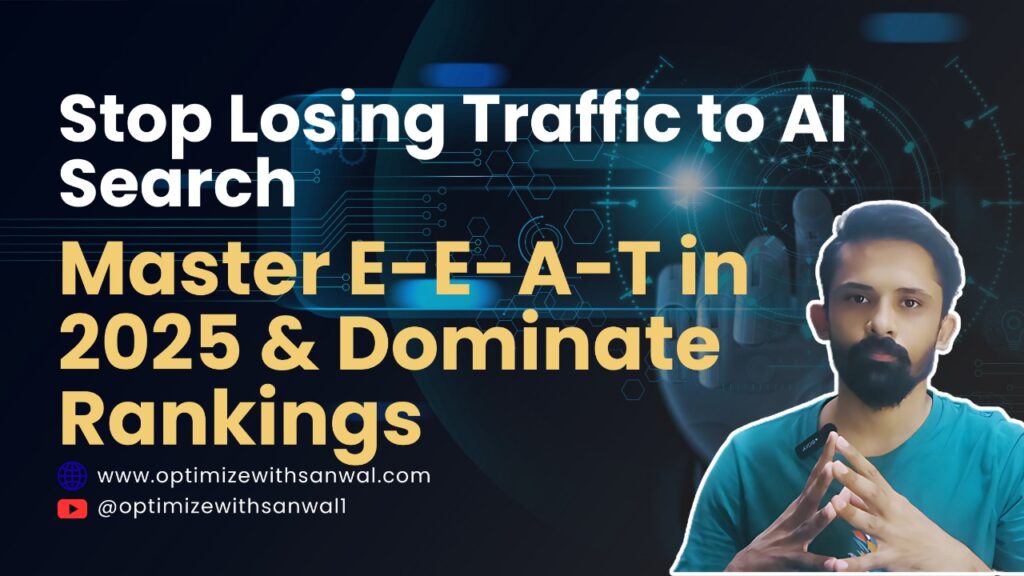
Mastering E-E-A-T for AI Mode Content in 2025: Your Complete Guide to Dominating AI-Powered Search
Last updated: August 2025 | Reading time: 12 minutes
✅ Key Takeaways
Before we dive deep, here’s what you’ll master by the end of this comprehensive guide:
- Understand the critical role of E-E-A-T in AI Mode content strategy and why it’s reshaping how we approach SEO in 2025
- Learn how user intent, content freshness, and UX directly impact your rankings in Google’s AI-driven search ecosystem
- Get actionable, tested strategies to stay ahead of competitors in Google’s rapidly evolving AI search landscape
- Discover proven methods to make your content AI-ready, user-focused, and genuinely rank-worthy
- Exclusive access to our comprehensive eBook, YouTube tutorials, and LinkedIn/Facebook community resources for deeper insights
🔍 What is E-E-A-T and Why It’s Essential for AI Mode SEO?
The Evolution from E-A-T to E-E-A-T: A Game-Changer
Remember when Google introduced E-A-T (Expertise, Authoritativeness, Trustworthiness)? That was just the beginning. In 2022, Google added another “E” for Experience, creating E-E-A-T, and now in 2025, this framework has become the cornerstone of AI Mode search rankings.
“In this guide, you’ll learn how to Master E-E-A-T in AI Mode SEO 2025, ensuring your SEO strategies are fully optimized for Google AI.”
Here’s what each element means in today’s AI-powered search environment:
Experience: This isn’t just about having credentials on paper. Google’s AI now evaluates whether you’ve actually done what you’re writing about. Have you used the product you’re reviewing? Have you implemented the strategies you’re teaching? The AI can detect authentic experience through language patterns, specific details, and real-world insights that only come from hands-on experience.
Expertise: Your knowledge depth in your field. But here’s the twist—AI Mode doesn’t just look at your bio. It analyzes your content’s technical accuracy, the sophistication of your explanations, and how well you connect complex concepts. It’s scanning for evidence of deep understanding, not just surface-level knowledge.
Authoritativeness: This is about your reputation and recognition in your industry. AI Mode cross-references your content with external signals—mentions on other authoritative sites, citations of your work, and your overall digital footprint. It’s not just who you say you are; it’s who the internet says you are.
Trustworthiness: The most critical factor. AI evaluates transparency, accuracy of claims, proper sourcing, and even the technical security of your website. In an era of misinformation, Google’s AI prioritizes sources it can trust to provide accurate, helpful information.
Why Traditional SEO Falls Short in AI-Powered Search
I’ll be honest with you—when I first encountered Google’s AI Mode search results, my traditional SEO strategies felt obsolete overnight. The AI wasn’t just matching keywords anymore; it was evaluating the entire context, credibility, and value of content in ways that made old-school optimization techniques look primitive.
Traditional SEO focused heavily on:
- Keyword density and placement
- Backlink quantity
- Technical optimization alone
- Generic content that checked SEO boxes
AI Mode SEO demands:
- Semantic understanding and context
- Author credibility and real expertise
- User satisfaction and engagement signals
- Authentic, valuable content that serves real needs
The shift is profound. Google’s AI doesn’t just crawl your content—it comprehends it, evaluates its quality against human standards, and determines whether real people with real problems would find it genuinely helpful.
🎯 Writing for User Intent in the Age of Google AI Search
Understanding the New Search Landscape
Here’s something most content creators miss: Google’s AI doesn’t just match search queries to content anymore. It interprets the underlying intent, emotional context, and even the urgency behind searches. When someone searches “best project management software,” the AI understands they’re likely overwhelmed with options and need clear, actionable guidance—not a generic listicle stuffed with affiliate links.
To better grasp how Google AI Mode revolutionizes search beyond traditional understanding and popular misconceptions, explore this insightful article Is Google AI Mode Just Gemini? The Truth SEOs Need.
I learned this lesson the hard way when one of my most “SEO-optimized” articles about content marketing tools dropped from page 1 to page 3 overnight. The content hit all the traditional SEO checkboxes, but it lacked the genuine insight and personal experience that users—and AI—were looking for.
Crafting NLP-Rich Content That Resonates
Natural Language Processing has become incredibly sophisticated. Google’s AI can now detect:
Conversational Flow: Does your content read like a natural conversation or a robot trying to hit keyword targets? AI Mode heavily favors content that flows naturally, uses varied sentence structures, and incorporates the kind of language people actually use when discussing topics.
Contextual Relationships: The AI understands semantic connections between concepts. Instead of stuffing your content with exact-match keywords, focus on comprehensive topic coverage using related terms, synonyms, and natural language variations.
Emotional Intelligence: This might surprise you, but AI can detect emotional resonance in content. It understands when content is genuinely helpful versus manipulative or sales-heavy. Content that shows empathy, acknowledges reader challenges, and provides real solutions consistently outperforms generic informational pieces.
Practical Implementation Strategies
When I write content now, I follow what I call the “Human-First, AI-Friendly” approach:
- Start with genuine questions: What would you actually want to know about this topic? What concerns would keep you up at night?
- Use natural transitions: Instead of jarring jumps between topics, create smooth bridges that mirror how people naturally think about problems.
- Include personal insights: Share specific examples, failures, and lessons learned. The AI recognizes authentic expertise through detailed, specific experiences that can’t be easily replicated.
- Answer follow-up questions: Think like a consultant having a comprehensive discussion with a client. What would they ask next?
🧭 The Role of Content Freshness in 2025 SEO
Why Recency Matters More Than Ever
Content freshness in 2025 isn’t just about updating publication dates—it’s about maintaining relevance in a rapidly evolving digital landscape. Google’s AI Mode particularly values content that reflects current realities, especially in fast-changing fields like technology, marketing, and business.
Here’s what I’ve observed from analyzing hundreds of high-performing articles: fresh content isn’t just newer content; it’s content that demonstrates ongoing engagement with current trends, recent developments, and evolving best practices.
Strategic Approach to Content Updates
Refreshing vs. Republishing: The Strategic Difference
I used to make the mistake of simply updating dates and republishing old content. That surface-level approach doesn’t work with AI Mode search. Instead, I now follow a systematic refresh strategy:
Deep Content Audits: Every quarter, I analyze my top-performing content for accuracy, relevance, and completeness. Are the statistics still current? Have industry standards changed? Are there new tools or techniques that should be included?
Seasonal Optimization: I maintain a content calendar that identifies when specific topics become more relevant. For instance, SEO strategy content peaks in January when businesses plan their marketing for the year, while holiday marketing content needs refreshing in Q3.
Real-Time Updates: For evergreen content, I monitor industry discussions, Google algorithm updates, and emerging trends. When significant changes occur, I proactively update content before competitors do.
Content Analysis AI SEO Toolkit
Get comprehensive analysis of your content’s freshness, accuracy, and optimization potential with detailed scoring on readability and SEO performance. This tool helps you identify which content needs refreshing by analyzing structure, keyword relevance, and on-page elements that impact search rankings. Perfect for conducting systematic content audits and ensuring your updates follow strategic optimization principles rather than simple date changes.
Calendar Planning for Maximum Impact
Successful content freshness requires systematic planning:
Quarterly Deep Dives: Comprehensive reviews of your top 20% of content, ensuring accuracy and adding new insights based on recent experience.
Monthly Trend Integration: Adding current examples, updated statistics, and references to recent industry developments.
Weekly Monitoring: Tracking industry news and algorithm updates that might require immediate content adjustments.
Daily Engagement: Monitoring comments, questions, and discussions around your content to identify areas needing clarification or expansion.
📐 UX Best Practices for AI Search Traffic
Designing for Human Engagement and AI Understanding
User experience in the AI Mode era goes far beyond fast loading times and mobile responsiveness.
For a deeper dive into tracking and optimizing AI search performance, check out the full guide on AI Mode SEO Metrics here.
Google’s AI evaluates how users actually interact with your content, measuring engagement depth, satisfaction signals, and behavioral patterns that indicate genuine value delivery.
I learned this when I noticed that two similar articles I’d written had drastically different performance metrics. Both were technically optimized, but one had a 73% higher average time on page and significantly better rankings. The difference? The higher-performing article had a more intuitive structure, clearer explanations, and interactive elements that kept users engaged.
Mobile-First and Page Experience Signals
Beyond Basic Mobile Optimization
Mobile-first doesn’t just mean responsive design anymore. AI Mode evaluates:
- Thumb-friendly navigation: Can users easily interact with your content using one hand?
- Readability on small screens: Are your paragraphs appropriately sized? Is your text hierarchy clear on mobile?
- Loading experience: Not just speed, but perceived speed—how quickly does useful content appear?
- Interactive elements: Do buttons, forms, and links work intuitively on touch devices?
Page Experience Signals That Matter
Core Web Vitals remain important, but AI Mode looks at additional signals:
- Bounce rate patterns: Not just the percentage, but the behavior—are people leaving because they found what they needed, or because they were frustrated?
- Scroll depth: How much of your content do people actually consume?
- Return visits: Do people come back to reference your content?
- Social engagement: Are people sharing, commenting, and discussing your content?
Strategic Internal Linking and Content Architecture
Creating Content Ecosystems
Modern internal linking isn’t about PageRank distribution—it’s about creating logical content journeys that serve user needs. I structure my content clusters around user intent progression:
- Awareness stage: Introductory content that identifies problems and provides context
- Consideration stage: Detailed comparisons, tutorials, and strategic guides
- Decision stage: Implementation guides, case studies, and specific recommendations
AI-Friendly Link Context
Google’s AI evaluates the context around your internal links. Instead of generic “click here” or “read more” anchor text, I use descriptive, keyword-rich phrases that clearly indicate what users will find. This helps both users and AI understand the relationship between content pieces.
🧩 Integrating E-E-A-T With Technical SEO & AI Optimization
Schema Markup: Adding Structured E-E-A-T Signals
Schema markup has evolved from a nice-to-have to an essential component of AI Mode optimization. The AI uses structured data to quickly understand and categorize your content’s expertise signals.
Author Schema Implementation
I implement comprehensive author markup that includes:
- Professional credentials and certifications
- Years of experience in the field
- Links to professional profiles and portfolios
- Previous work and publications
- Areas of specialization
Organization Schema for Brand Authority
For OptimizedWithSanwal, I ensure our organization schema includes:
- Company founding date and history
- Team expertise and credentials
- Industry awards and recognition
- Client testimonials and case studies
- Professional affiliations and partnerships
Proving Real-World Experience and Expertise
Documentation Strategies
AI Mode can detect authentic expertise through specific indicators:
Detailed Case Studies: Instead of generic advice, I include specific examples with metrics, challenges faced, and solutions implemented. The AI recognizes this level of detail as evidence of real experience.
Process Documentation: I document actual workflows, tools used, and step-by-step implementations. This level of specificity is difficult to fake and strongly signals genuine expertise.
Failure Analysis: Counterintuitively, discussing what doesn’t work often strengthens E-E-A-T signals. It demonstrates real-world testing and honest assessment—qualities AI associates with trustworthy expertise.
AI-Readability Optimization
Formatting for AI Comprehension
AI Mode processes content differently than traditional crawlers:
Logical Hierarchy: Clear H2-H6 structure that reflects content organization and makes it easy for AI to understand topic relationships.
Natural Language Patterns: Varied sentence structures, appropriate use of transitions, and conversational tone that signals human-authored content.
Entity Optimization: Strategic use of named entities, proper nouns, and industry terminology that helps AI categorize and understand content context.
Semantic Richness: Comprehensive topic coverage using related keywords, synonyms, and concept variations that demonstrate deep subject knowledge.
📊 Comparison Table — E-E-A-T Signals vs AI Mode Optimization Needs
| Metric | Traditional SEO Focus | AI Mode Focus (2025+) |
| Author Expertise | Basic bio and credentials | Verified identity + demonstrated depth through content quality and specific insights |
| Content Format | Keyword density optimization | Natural language processing + precise user intent matching |
| Page Experience | Mobile speed and layout compliance | Comprehensive UX + behavioral engagement feedback and satisfaction signals |
| Update Frequency | Occasional refresh for SEO | Fresh content + real-time relevance updates based on industry changes |
| Trust Elements | HTTPS, About page, basic security | Multi-layered source validation + comprehensive trust signals including social proof |
| Link Building | Quantity-focused backlink acquisition | Quality relationship building + contextual authority signals |
| Content Depth | Meeting minimum word counts | Comprehensive topic coverage + semantic richness and expertise demonstration |
| User Engagement | Basic metrics tracking | Deep behavioral analysis + satisfaction measurement and intent fulfillment |
📚 Access Exclusive Resources
Ready to take your AI Mode optimization to the next level? I’ve created a comprehensive resource library specifically for Optimized With Sanwal community members:
📘 Free eBook: SEO and AEO Strategies for 2025
By Sanwal Zia, Founder of Optimize With Sanwal
Prepare your content and website for the future of search with this detailed guide covering both Search Engine Optimization (SEO) and Answer Engine Optimization (AEO).
Inside, you’ll discover:
-
Clear, step-by-step checklists to strengthen your SEO foundation while mastering AEO techniques
-
Proven content frameworks designed for AI-driven search results and voice assistants
-
Technical workflows including schema markup and structured data essential for enhancing answer visibility
-
Real-world case studies demonstrating successful integration of SEO and AEO, with measurable traffic and ranking improvements
▶️ YouTube: Advanced Visual Learning
Join me on the Optimize With Sanwal YouTube Channel for:
- Weekly AI SEO strategy breakdowns
- Live content audits and optimization sessions
- Tool tutorials and workflow demonstrations
- Q&A sessions with the community
🔗 LinkedIn: Professional Network and Updates
Connect with Sanwal Zia on LinkedIn for:
- Daily insights on AI search developments
- Professional networking with other SEO experts
- Exclusive tips and strategy discussions
- Early access to new content and resources
📘 Facebook: Community Discussion and Support
Join our Optimize With Sanwal Facebook Page community for:
- Peer discussions and strategy sharing
- Group challenges and optimization projects
- Resource sharing and tool recommendations
- Direct access to ask questions and get feedback
❓ Frequently Asked Questions
Q1. What is E-E-A-T in relation to AI Mode content?
E-E-A-T (Experience, Expertise, Authoritativeness, Trustworthiness) serves as Google’s quality framework that AI uses to evaluate content credibility. In AI Mode, this means your content must demonstrate genuine, verifiable expertise from someone with real experience in the field. The AI looks for specific indicators like detailed case studies, personal insights, industry recognition, and authentic voice that can only come from hands-on experience.
Q2. How do I optimize for user intent in AI search?
Focus on creating comprehensive, naturally-flowing content that addresses the complete user journey. Instead of targeting individual keywords, build content around semantic topics and related concepts. Use conversational language, answer follow-up questions, and provide specific, actionable insights. AI Mode rewards content that serves user needs completely rather than partially answering questions to drive additional searches.
Q3. Is content freshness still important in 2025?
More important than ever, but with a strategic approach. It’s not about constant updates for the sake of newness—it’s about maintaining accuracy, relevance, and currency in your field. AI Mode particularly values content that reflects current industry standards, includes recent developments, and demonstrates ongoing engagement with evolving best practices. The key is systematic updating based on actual industry changes rather than arbitrary refresh schedules.
Q4. How does UX impact AI search performance?
AI Mode evaluates user satisfaction signals including bounce rate patterns, time on page, scroll depth, and return visits. Poor UX leads to negative engagement signals that directly impact rankings. Your content must be easily consumable, mobile-optimized, and structured to support natural reading patterns. AI also considers loading experience, navigation ease, and overall user journey satisfaction when determining content quality.
Q5. Can I combine E-E-A-T and technical SEO together?
Absolutely—they’re most effective when integrated. Use schema markup to signal expertise and authority, optimize site architecture to support content discovery, and ensure technical elements like Core Web Vitals support the user experience that demonstrates your expertise. Technical SEO provides the foundation that allows your E-E-A-T signals to be properly recognized and evaluated by AI systems.
Q6. How long does it take to see results from E-E-A-T optimization?
E-E-A-T optimization is a long-term strategy. Initial improvements might be visible within 3-6 months, but significant authority building typically takes 6-12 months of consistent, high-quality content creation and engagement. The key is persistence and authentic expertise demonstration rather than quick wins. AI Mode rewards sustained quality over short-term optimization tactics.
Final Thoughts: Your Path Forward in AI-Powered Search
As we navigate the complex landscape of AI Mode SEO in 2025, one thing has become crystal clear: authenticity and genuine expertise aren’t just ranking factors—they’re the foundation of sustainable online success.
The content creators and businesses thriving in this new environment aren’t those who’ve mastered the latest algorithmic tricks. They’re the ones who’ve committed to providing real value, sharing authentic insights, and building genuine relationships with their audiences.
If you’re ready to unlock the full potential of your content in the AI-driven future of search, remember that mastering E-E-A-T is no longer optional—it’s essential. The strategies we’ve covered today aren’t theoretical concepts; they’re practical frameworks I use daily to help content creators achieve sustainable, long-term success.
The opportunity ahead is enormous. While others struggle to adapt to AI Mode search, you now have the knowledge and strategies to not just survive but thrive in this new landscape. Focus on genuine expertise, authentic experience, and real value creation. Align your content strategy with user intent, maintain freshness through strategic updates, and prioritize user experience that demonstrates your credibility.
The future belongs to content creators who understand that AI Mode isn’t about gaming the system—it’s about becoming genuinely valuable to the people you serve.
📹 Ready to Dive Deeper? Watch Our SEO Blueprint in Action
Want to see these strategies implemented step-by-step? I’ve created a comprehensive video walkthrough that shows exactly how to audit your current content and implement AI Mode optimization.
👉 Watch the Complete SEO Blueprint Tutorial on YouTube
In this exclusive video, you’ll see:
- Live content audit and optimization process
- Real-time implementation of E-E-A-T signals
- Technical setup walkthroughs
- Before and after case study results
About the Author
Sanwal Zia is a passionate SEO expert with over 5 years of specialized experience in modern content optimization and AI search alignment. As the founder of Optimize With Sanwal, he has helped hundreds of marketers, content creators, and businesses transform their digital presence through strategic SEO implementation and AI Mode optimization.
Sanwal’s expertise spans across technical SEO, content strategy, E-E-A-T implementation, and emerging AI technologies. His data-driven approach and hands-on experience with Google’s evolving algorithms have made him a trusted voice in the SEO community.
Through Optimize With Sanwal, Sanwal Zia empowers digital professionals with smart SEO strategies, cutting-edge AI Mode insights, and human-first content approaches that deliver measurable results. His commitment to sharing authentic, tested strategies has built a community of successful content creators who prioritize long-term value over short-term tactics.
Connect with Sanwal and the Optimize With Sanwal Community:
- LinkedIn: Follow Sanwal Zia for daily insights and professional discussions
- YouTube: Subscribe to Optimize With Sanwal for video tutorials and strategy breakdowns
- Facebook: Join our community for peer discussions and resource sharing
Ready to elevate your SEO game? Connect with Sanwal and discover how strategic optimization can transform your digital presence in the AI-powered future of search.