
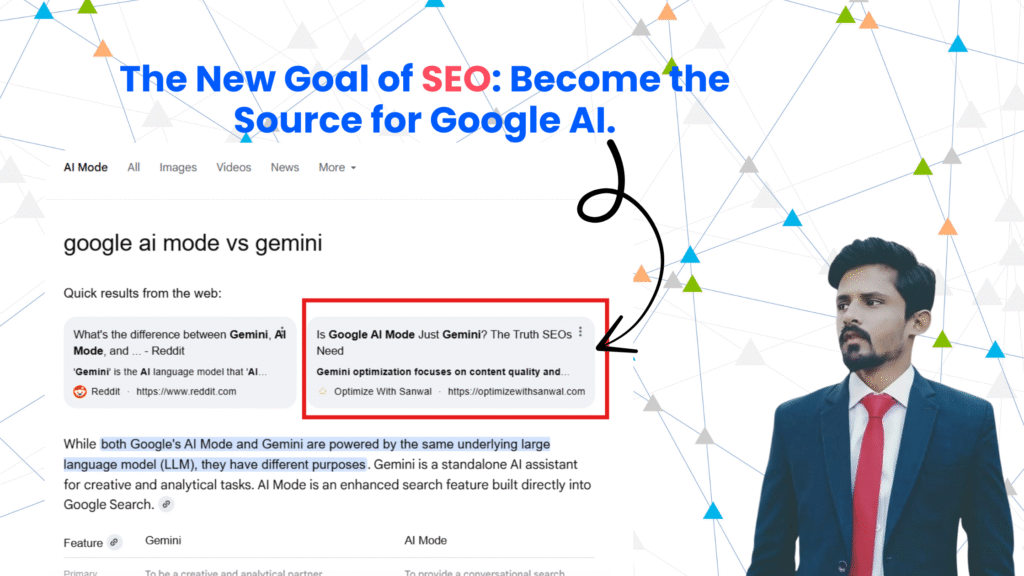
The field of Search Engine Optimization is facing its most significant transformation in a decade. For years, the core anxiety among professionals has been the rise of AI and the threat of the “zero-click search,” a future where Google answers every question directly, making websites obsolete. This uncertainty has left many strategists wondering about the future viability of their work. However, recent communications from inside Google’s AI search team have pierced through this fog, offering not a threat, but a clear, strategic direction forward.
On August 25, 2025, Robby Stein of Google’s AI Search team released a statement that redefines the relationship between AI and content creators. It confirmed that the future is not about replacing websites, but about integrating them more deeply into AI-generated answers. This article is a strategic deconstruction of what these changes demand from us. We will go beyond the surface-level news to build an actionable playbook for thriving in the new era of AI search and SEO.
How Is AI Changing the Basic Idea of a Google Search?
For twenty years, a Google search was a transaction: you asked a question, and Google provided a list of documents—ten blue links—for you to investigate. The fundamental model was that of a library catalog. Your job as an SEO was to make your document the most appealing entry in that catalog.
AI search dismantles this model. Google is transitioning from a library catalog to an answer engine. The new goal is to provide a direct, synthesized answer in a conversational format. The critical insight from Robby Stein Google AI communications is that this new model relies heavily on citing its sources. The “conversation” will be footnoted in real-time.
The key shifts are:
- From Lists to Synthesis: Instead of just showing you a list of potential answers (websites), the AI will read them, understand them, and synthesize a single, comprehensive answer.
- From Links-as-Results to Links-as-Citations: Links in AI answers will no longer be the result itself. They will be the proof, the source, the “show your work” that backs up the AI’s claims. They are citations that invite the user to dig deeper.
This isn’t a minor update; it’s a re-architecting of how information is presented. It means our job is no longer just to be on a list but to become a foundational source of truth for the AI itself.
Why Does Google Want to Put Links Inside AI Answers?
Understanding Google’s motivation is the first step in building a winning strategy. This move isn’t an act of charity for publishers; it’s driven by critical needs related to user trust, technical limitations, and the quality of user engagement.
Is This About User Trust?
Absolutely. Google’s dominance is built on the public’s trust in its results. An AI that presents information without sources is an untrustworthy “black box.” Users, especially for important queries, want to know where information comes from. Inline links in AI search act as a verification layer. It’s a direct nod to Google’s E-E-A-T (Experience, Expertise, Authoritativeness, and Trustworthiness) principles, proving that the AI’s response is grounded in the expertise of real-world sources.
How Do Links Help AI Accuracy?
Large Language Models (LLMs) have a well-documented flaw: they can “hallucinate,” or invent facts. For a search engine, presenting false information is a catastrophic failure. By forcing the AI to ground its answers in and link to specific text on authoritative web pages, Google reduces the risk of hallucinations. Your high-quality content becomes the factual anchor that ensures the AI’s accuracy.
What Does This Mean for Website Traffic Quality?
This is the most pressing question: How AI affects website clicks? The new model will likely reduce the quantity of low-intent clicks. Users asking simple, factual questions may get their answer without ever clicking. However, the quality of the clicks that do occur will increase dramatically.
A click on a contextual link for SEO is a high-intent action. The user has already received a summary from the AI and is now clicking your link for one of two reasons:
- Deepening Understanding: They want more detail, nuance, or data about the specific point you were cited for.
- Verifying Trust: They want to evaluate the source of the information themselves.
These are highly engaged visitors, not casual browsers. They are far more likely to convert, subscribe, or become a long-term reader.
What Is the New SEO Playbook for an AI-Powered Google?
Optimizing for Google’s AI Mode requires a fundamental shift in how we approach content. The goal is no longer to simply rank for a keyword, but to become an indispensable source of information that the AI must cite. This playbook is built on three strategic pillars.
How Can My Brand Become an Authority Entity?
Google now operates on an “entity-first” model. It understands brands, people, and concepts as interconnected entities, not just strings of keywords. To be cited, your brand must be recognized as an authoritative entity on your topic.
- Build Topic Clusters: Stop writing random blog posts. Structure your knowledge around a “pillar and cluster” model. Identify the core pillars of your expertise and build a comprehensive pillar page for each. Then, surround it with dozens of “cluster” articles that answer every conceivable question about that topic in exhaustive detail. This demonstrates to Google that your expertise is deep, not wide and shallow.
- Lean into “Experience”: The “E” in E-E-A-T is your human advantage. Showcase firsthand experience. Include unique case studies, proprietary data, personal anecdotes, and detailed author bios. Prove that your content was written by experts who have done the work, not by a machine summarizing other machines.
What Is a “Citable Moment” and How Do I Create One?
To be linked to, your content must contain “citable moments”—discrete, high-value pieces of information that an AI can easily extract and attribute.
- Prioritize Factual Density: Review your content and replace vague statements with hard facts.
- Weak: “Many people use this strategy.”
- Citable: “Our 2025 study of 500 businesses found that 72% of CMOs implemented this strategy, leading to an average 15% increase in MQLs.”
- Generate Original Knowledge: The ultimate citable moment is a piece of information that exists nowhere else. Commission surveys, conduct experiments, analyze your internal data, or interview a panel of experts to create truly unique statistics and insights. This is the future of link building SEO—building assets that others, including Google’s AI, have no choice but to cite.
- Structure for Extraction: Format your content to make these moments easy to grab. Use tables for data, blockquotes for key quotes, and bulleted lists for key takeaways.
Why Is Content Structure So Important for AI?
For an AI to use your content, it must first understand it unambiguously. Clean, logical structure is no longer just for the user; it’s a technical requirement for machine readability.
- Use Schema Markup Religiously: Schema is the vocabulary you use to speak directly to search engines. Implement FAQPage schema on pages that answer questions, HowTo schema for instructions, and Article schema with detailed author information. This removes guesswork and tells the AI exactly what your content is and who wrote it.
- Write with Clarity and Precision: Use a logical heading hierarchy (H1, H2, H3) to map out your arguments. Employ simple sentence structures (subject-verb-object) and precise vocabulary. Avoid jargon and ambiguous language. The easier your content is to parse, the more likely an AI will be able to use it accurately.
What Is the “Google Web Guide” and How Do I Get Featured?
One of the most exciting opportunities mentioned in the Google Web Guide experiment. This feature is an AI-curated collection of the most useful web links for complex queries. Think of it as a bibliography for a search, hand-picked by the AI.
Getting featured in a Web Guide is the ultimate validation of your topical authority. It means Google’s AI has not just cited you for a single fact but has identified your entire website as a critical resource for understanding a topic. The strategy to get there is the culmination of everything discussed: build deep topic clusters, demonstrate firsthand experience, and become the primary source for original data in your field.
Will AI Search Show My Website At All?
This is the final, crucial question. The answer is a strategic “it depends.”
- For simple, factual queries: Your website will likely not be shown. The AI will provide the answer, and the search journey will end there. Websites built on providing simple, easily aggregated facts will face significant challenges.
- For complex, research queries: Yes. This is where the opportunity is greatest. For questions that require nuance, comparison, and multiple viewpoints, the AI will act as a research assistant, and your site will be featured as a key source or a part of the Web Guide.
- For transactional and commercial queries: Yes. When a user shows intent to buy a product or service, the AI’s role will be to guide them to the businesses that can fulfill that need. The presentation will change, but the commercial connection to websites will remain strong.
The future role of the SEO strategist is to move content out of the first category and firmly into the second and third. Your job is to create content that is so valuable, so detailed, and so full of unique expertise that the AI cannot provide a complete answer without referencing you.
Your role is shifting from a technician who masters an algorithm to a strategist who informs an intelligence. It’s a more challenging role, but it’s also a more important one than ever before.
About the Author
Sanwal Zia is an SEO Strategist with five years of experience. He is the founder of Optimize With Sanwal, a firm dedicated to creating effective search strategies for businesses.
Connect with Sanwal: