
I have worked with SEO managers, consultants, agency owners, and enterprise content teams for years, and one thing has stayed consistent. The people who win are not the ones who chase every new tool. The people who win are the ones who understand where AI actually improves performance and where strategy still matters.
In 2026, AI did not replace SEO. It replaced the parts of SEO that were slow, repetitive, or inefficient. It removed manual friction. It tightened workflows. It helped me respond faster and with greater clarity. What it did not do was eliminate the need for judgment, structure, or decision making.
This pillar focuses on the three categories where AI genuinely helps me move the needle. AI for Local SEO. AI for SERP and competitor intelligence. AI for programmatic SEO. These categories connect directly to visibility, relevance, and scalability. They are also the categories least affected by AI Overviews because they require accuracy, structure, and interpretation.
Executive Summary
If I had to simplify my approach to AI for SEO in 2026, here is what I would say. Local SEO is heavily shaped by rapid changes in Google Business Profiles and SGE local panels, and AI tools help me track and interpret those changes. SERP intelligence tools help me understand not only what users search for, but how search results behave. And programmatic SEO gives me the strongest long term compounding growth because it lets me scale structured content cleanly and consistently.
These three areas consistently give me the most reliable performance improvements.
The State of SEO in 2026
Search is more layered than ever. AI Overviews, dynamic SERP layouts, commercial modules, entity driven panels, and classic organic results all coexist. Keyword volume is no longer enough to make decisions. The SERP itself is the data source that matters most.
I also see another clear shift. Scaling content manually creates a competitive disadvantage. Teams that understand strategy and rely on AI for execution consistently move faster and outperform others. The best results come from combining experience with automation.
Local SEO continues to play a major role in real world visibility and conversions. But it has also become more fluid because SGE and AI panels influence local intent in new ways. Programmatic SEO has become one of the most powerful growth levers because AI helps build structured pages at scale while maintaining consistency.
These three categories form the core of what I trust most.
How I Evaluate AI SEO Tools
I evaluate every AI tool based on friction. Tools must remove real problems. They must shorten the time between insight and action. The feature list does not matter unless it connects to execution.
The Bottleneck Test
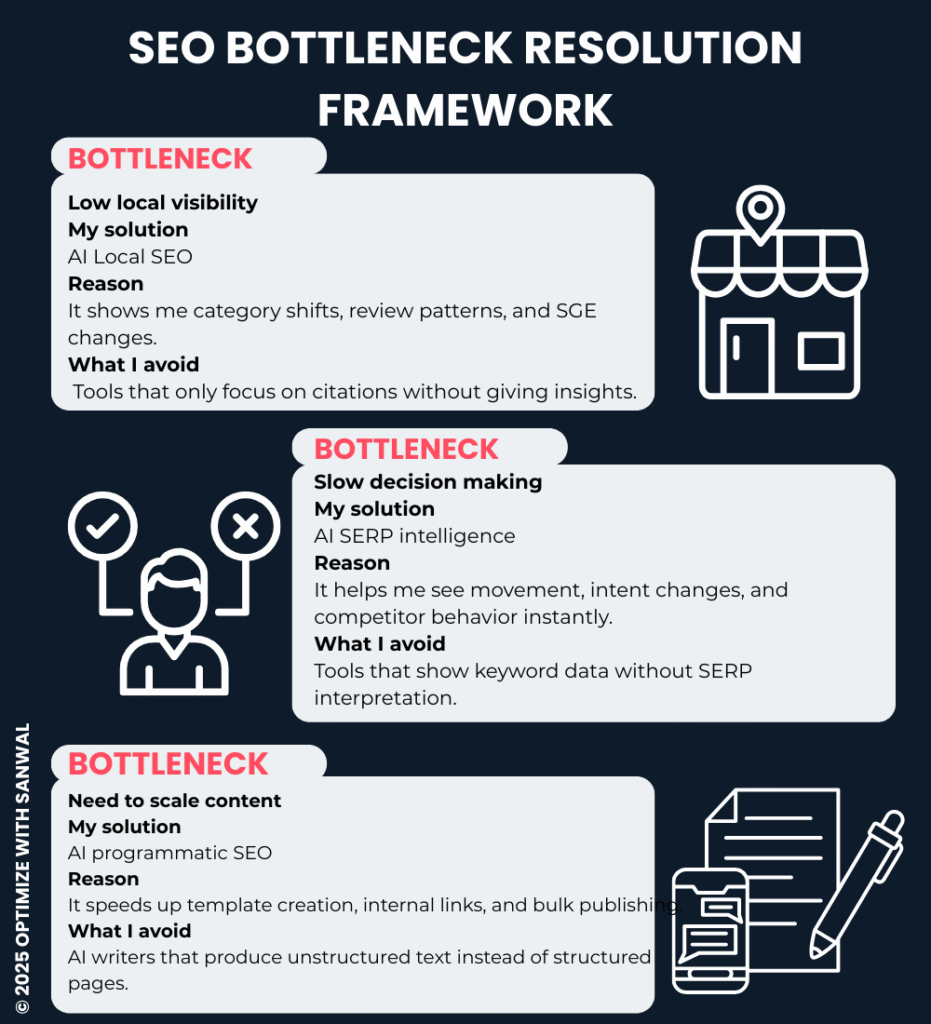
If my problem is low local visibility, then I choose AI Local SEO tools. If my problem is slow SERP interpretation, then I choose SERP intelligence tools. If my problem is producing or updating content at scale, then I choose programmatic SEO tools.
This makes tool selection practical and grounded.
The Team Structure Test
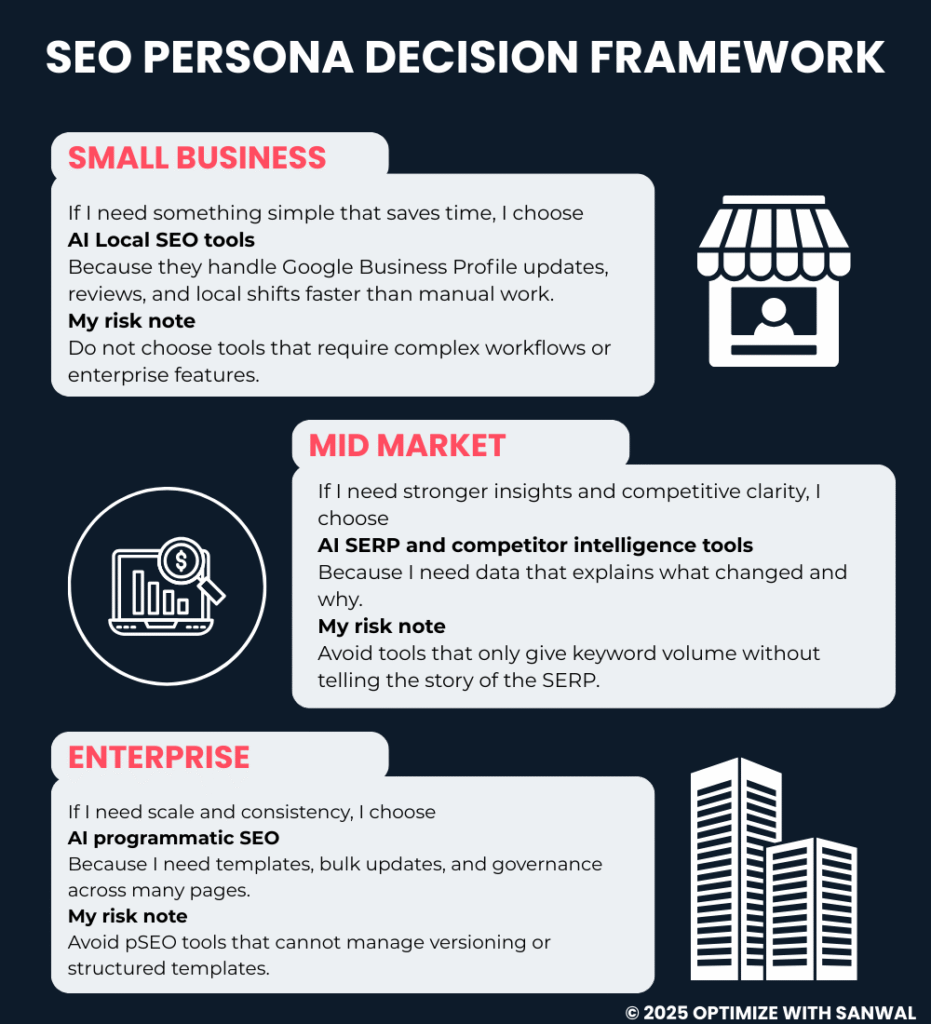
Small teams need simple workflows and automation. Mid market teams need accuracy, insight, and flexibility. Enterprise teams need scale, governance, templates, workflows, and consistency.
A tool that is excellent for a freelancer may not be useful for an enterprise team, and the reverse is also true.
The Budget Test
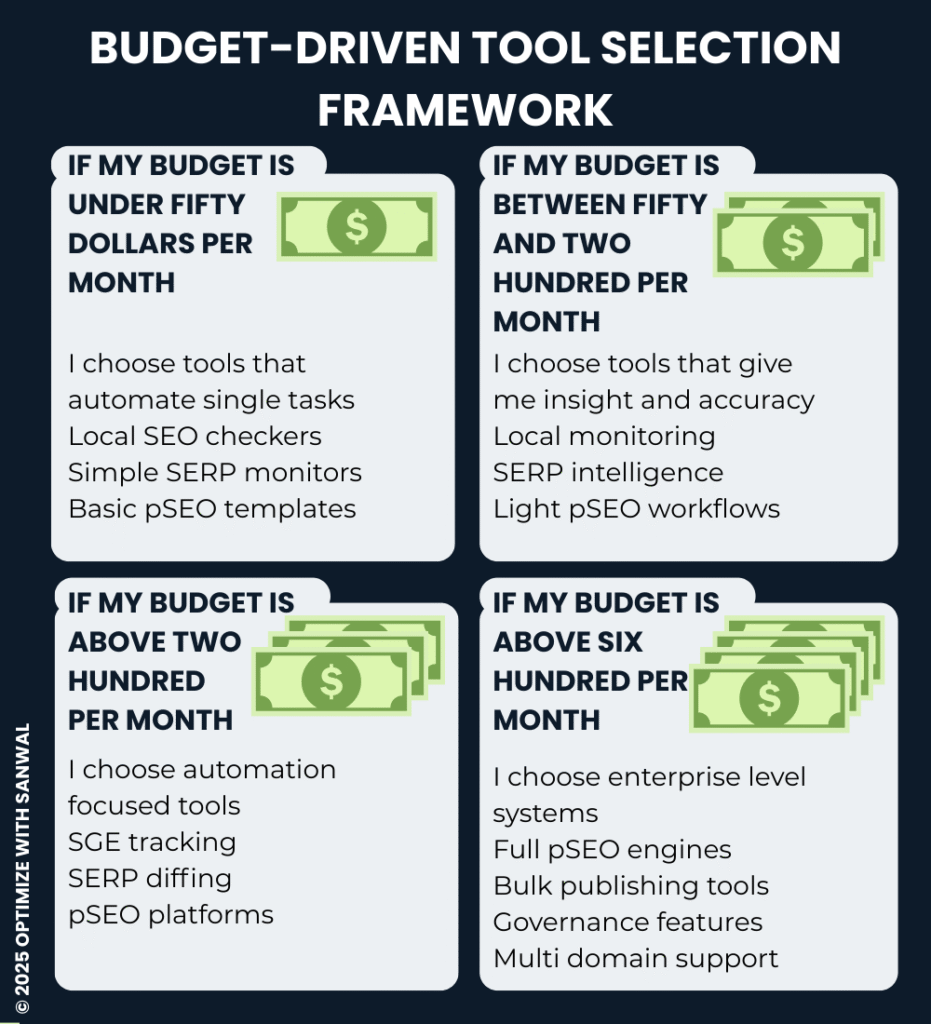
Budgets between forty nine and one ninety nine per month cover most of what small and mid market teams need. Budgets above two hundred per month open access to more advanced automation. Enterprise tier tools above six hundred per month focus on scale, versioning, bulk updates, and multiple domain management.
Budget decisions become simple when they follow bottleneck removal.
Category 1: AI for Local SEO
Local SEO evolves quickly. Google updates categories, suggested edits, attributes, and service information without notice. Reviews influence ranking more than before. SGE local panels replace traditional map packs in many queries. Local search behavior shifts faster than manual monitoring can track.
AI helps me stay ahead of these changes.
Where These Tools Help Me the Most
They notify me when something in a Google Business Profile changes. They help me track local pack movement and SGE local panels. They summarize review patterns and sentiment. They analyze competitor listings, photos, service descriptions, and categories.
These insights help me respond early instead of reacting late.
Key Patterns I Watch in Local Rankings
Categories now matter more than keywords. Review patterns matter more than review counts. Entity alignment helps listings appear in SGE panels. Freshness and completeness influence visibility. Competitor velocity also plays a role.
AI tools help me monitor these patterns without spending hours checking them manually.
How AI Changes Local Execution
Local SEO requires accuracy, clarity, and fast adjustments. AI reduces the time spent on review reading, profile scanning, and competitor tracking. Instead of guessing, I make decisions based on structured signals.
My Take
Local SEO has not become easier. It has become more complex. AI tools help me manage the changes with less friction and better precision. For any business that depends on local visibility, this category is essential.
Category 2: AI for SERP and Competitor Intelligence
Keyword tools provide numbers. SERP intelligence reveals real opportunity. Search results change weekly, and those changes often reveal future ranking shifts before any analytics platform does.
This is why I use AI for SERP interpretation.
What These Tools Help Me See Faster
They show when competitors move up or down. They reveal new entrants. They highlight intent changes. They track SERP layout shifts. They compare my pages with top ranking pages. They extract entities, schema, and content structures in seconds.
This used to require multiple tools and a lot of manual inspection.
Signals I Track That Humans Usually Miss
A rewritten competitor title usually predicts a ranking change. A domain that appears suddenly in SGE often signals a trend. A page that loses entity weight often drops soon after. A competitor that increases internal linking may gain visibility before rankings reflect it.
AI tools highlight these signals immediately.
Why This Category Is Becoming Essential
Google uses entity associations, intent modeling, freshness scores, engagement signals, and behavioral data to shape SERPs. Manual tracking cannot keep up with this pace.
AI helps me understand the competitive landscape in a way that is more relevant than keyword data alone.
My Take
SERP intelligence is the category that helps me make strategic decisions. It helps me avoid wasted time and focus on what produces results.
Category 3: AI for Programmatic SEO (pSEO)
Programmatic SEO produces some of the most stable and scalable growth I have seen. It allows teams to build hundreds of structured pages with consistency. AI expanded what pSEO can do by helping generate templates, internal linking rules, schema, meta tags, and dynamic fields.
This is where AI meets structured content at scale.
Why pSEO Matters More in 2026
Searchers look for attributes, variations, comparisons, and location based pages. Structured content naturally aligns with this behavior. AI Overviews also draw from structured pages when they need clear, factual information.
Programmatic pages give topical breadth and support multiple layers of search intent.
How I Use AI to Scale Structured Pages
AI helps me create flexible templates. It helps me fill dynamic fields. It helps me generate internal linking suggestions. It helps me maintain consistency across hundreds of pages. It helps me update pages in bulk without rewriting everything from scratch.
The structure remains human. AI helps produce and maintain it.
Where pSEO Produces Real Returns
Location based content, product variations, comparison pages, attribute pages, category pages, and industry breakdowns benefit the most from pSEO. These structures compound over time and help sites gain broad visibility.
My Take
Programmatic SEO is one of the highest ROI categories in modern SEO. It scales the work that matters and builds long term stability.
Comparison Snapshot
| Category | Best For | Value Provided | Why I Consider It Important |
| AI Local SEO | SMB to mid market | Faster insights and response times | Local packs and SGE shift quickly |
| SERP Intelligence | Mid market to enterprise | Better interpretation of competitive signals | SERPs evolve weekly |
| Programmatic SEO | Mid market to enterprise | Scalable content and consistency | Produces compounding growth |
Related Articles for Deeper Research
AI Tools for Local SEO in 2026
AI Tools for SERP and Competitor Research in 2026
AI Tools for Programmatic SEO in 2026
Frequently Asked Questions
Is AI replacing SEO?
No. AI replaces repetitive tasks, not the strategic work.
Do AI written pages rank?
Yes, when structure, purpose, and relevance are correct.
Does programmatic SEO still work?
It works better than before when templates and structure are thoughtful.
Is keyword research still useful?
Yes, but SERP behavior reveals more actionable insights.
Which category gives the strongest ROI?
For me, it is programmatic SEO.
My Final Recommendation
If I had to rely on only three categories of AI for SEO, I would choose AI Local SEO tools for real world visibility, AI SERP intelligence tools for competitive clarity, and AI programmatic SEO tools for scalable execution. These categories help me understand changes faster, act before competitors, and scale without sacrificing quality. They reflect how SEO actually works in 2026, where precision and speed matter more than volume.
“At Optimize With Sanwal, we combine human insight with AI-driven strategies to help businesses grow smarter and faster. You can explore these ideas further in our eBook When AI Becomes the Interface, which shows how content can align with both user needs and AI understanding.”
Disclaimer
All information published on Optimize With Sanwal is provided for general guidance only. Users must obtain every SEO tool, AI tool, or related subscription directly from the official provider’s website. Pricing, regional charges, and subscription variations are determined solely by the respective companies, and Optimize With Sanwal holds no liability for any discrepancies, losses, billing issues, or service-related problems. We do not control or influence pricing in any country. Users are fully responsible for verifying all details from the original source before completing any purchase.
About the Author
I’m Sanwal Zia, an SEO strategist with more than six years of experience helping businesses grow through smart and practical search strategies. I created Optimize With Sanwal to share honest insights, tool breakdowns, and real guidance for anyone looking to improve their digital presence. You can connect with me on YouTube, LinkedIn , Facebook, Instagram , or visit my website to explore more of my work.