
Let’s be honest, how many hours have you really spent lost in a spreadsheet, manually sorting hundreds, maybe thousands, of keywords? If you’re like me, it’s more than you’d like to admit. For years, that tedious work was the foundation of a solid SEO strategy. It was necessary, but it was a grind.
In my 5+ years in this field, I’ve seen how AI has started to change this process completely. It’s shifting keyword research from a manual, tactical chore into a high-level strategic activity. This guide is my personal take on how to leverage that shift.
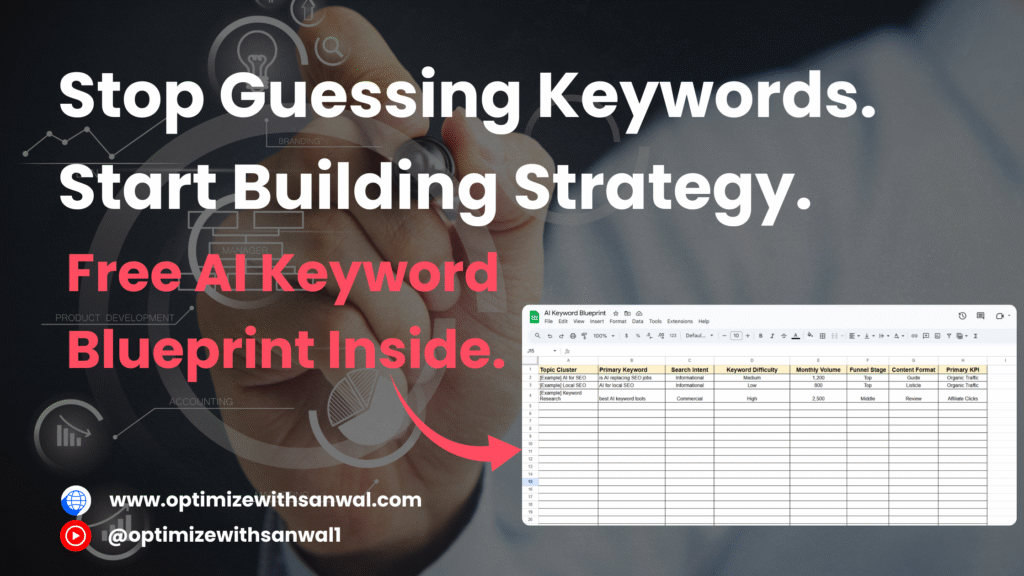
To help you apply these ideas, I’ve also developed an advanced tool I use with my clients: The Strategic AI Keyword Blueprint 2.0. We’ll explore how to use it as we go through this guide.

Why Do We Need to Change Our Approach to Keyword Research?
The simple answer is that Google has changed. Modern search engines, powered by sophisticated AI, no longer think in terms of simple keywords. They think in terms of topics and concepts.
This is why the strategy of “topic clustering”—creating a central pillar page with many supporting cluster articles—is so effective. It signals to Google that you have deep authority on a subject. The problem, as you know, is that manually organizing a massive keyword list into these logical clusters is slow and prone to error. This is the first major problem that AI solves.
How Does AI Find Deeper Keyword Opportunities?
Modern AI keyword research goes far beyond just generating lists of terms. It’s about finding strategic opportunities that your competitors have missed.
Uncovering Competitor Gaps
One of my favorite ways to use AI is for a quick and effective competitive analysis. Instead of manually reading a competitor’s article, I can use an AI to analyze it for me.
Example Prompt for ChatGPT or Gemini: “Act as an expert SEO content strategist. Analyze the content at https://neilpatel.com/blog/how-to-create-content-that-outranks-your-competitors-content/. What are its main arguments? What questions does it fail to answer? What related sub-topics could I cover to create a more comprehensive article?”
This process helps you find valuable content gaps to create a superior piece of content.
Analyzing User Intent at Scale
Understanding search intent is critical. Is the user looking to learn, or to buy? An AI can help categorize a list of keywords by their likely intent (Informational, Transactional, etc.) in seconds. As you’ll see in our blueprint, defining this before you write is a crucial step that ensures your content matches the user’s goal.
Discovering Semantic and Conversational Keywords
AI is also fantastic at understanding relationships between words. I often use tools like AnswerThePublic to find real questions people are asking. I can then feed those questions into an AI and ask it to find semantically related concepts. This gives you a list of related ideas, not just synonyms, making your content feel more natural and comprehensive.
What Is the Best Way to Build Topic Clusters with AI?
This is where AI truly transforms the workflow. Manually creating topic clusters is a nightmare. With AI, it becomes a strategic exercise.
The process I use is simple:
- Gather Your Data: Start with a large “seed list” of keywords from a tool like Ahrefs or Semrush.
- Give the AI a Role: Feed the entire list to a capable AI (like ChatGPT-4 or Claude). Start with a powerful prompt: “Act as an SEO strategist. I’m providing a list of keywords. Your task is to organize them into logical topic clusters. For each cluster, identify the best ‘pillar’ keyword and the supporting ‘cluster’ keywords.”
- Refine the Output: My experience shows that the AI’s first attempt is usually about 70-80% right. Your job, as the human strategist, is to do the final 20% of refinement. You’ll check the AI’s logic, combine or split clusters, and ensure the final structure aligns with your business goals.
How Do You Use The Strategic AI Keyword Blueprint 2.0?
The blueprint is where strategy becomes action. It ensures every piece of content you create has a clear purpose. Here is a breakdown of the new, more advanced version.
Click the link to access the complete blueprint
Get the Blueprint
| Column | Purpose |
| Topic Cluster | The high-level pillar topic. |
| Primary Keyword | The main target keyword for the article. |
| Search Intent | Informational, Transactional, etc. |
| Keyword Difficulty | An estimated score (e.g., Low, Medium, High) to prioritize effort. |
| Monthly Volume | The estimated monthly search volume to gauge potential reach. |
| Funnel Stage | Top, Middle, or Bottom of the marketing funnel. |
| Content Format | The best format for the topic (e.g., Guide, Listicle, Case Study, Tool). |
| Primary KPI | The main goal of the article (e.g., Organic Traffic, Email Sign-ups, Demo Requests). |
Your Complete Guide to AI Keyword Research
This article provides the strategy, but the real work is in the execution. These supporting guides will dive deeper into the specific tactics we’ve discussed.
- A Guide to Finding Long-Tail Keywords with ChatGPT: A step-by-step tutorial with copy-and-paste prompts.
- How to Create SEO Content Briefs with AI: Turn your keyword research into a perfect, actionable brief for your writers.
- Analyzing Search Intent at Scale: A deep dive into using AI to understand exactly what your audience wants.
- How to Perform a Competitor Keyword Analysis with AI: My workflow for finding what your competitors are missing.
- The Best AI-Powered Keyword Research Tools: A review of the top tools on the market today.
My Final Thoughts
AI is shifting our role from data sorters to data strategists. It automates the most tedious parts of keyword research, which frees us up to do the high-impact work that machines can’t: thinking critically, understanding our audience, and building a content strategy that drives real business results.
My best advice is to embrace this shift. Start using these techniques and tools, beginning with the blueprint I’ve shared. You’ll find you can build better content plans in a fraction of the time.
About Me
I’m Sanwal Zia, a certified SEO strategist and the founder of Optimize with Sanwal. With expertise recognized by prestigious organizations, I focus on building effective search strategies that drive growth. You can connect with me directly on my Website, LinkedIn, Facebook, and Instagram.