
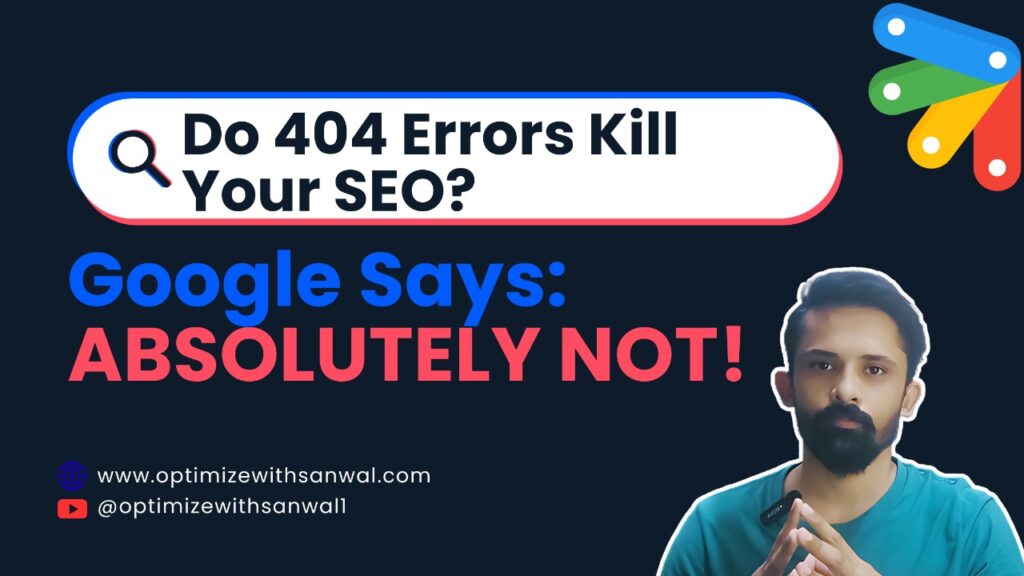
What Do 404 Errors Mean? Expert SEO Insights by Optimize With Sanwal
Introduction
Picture this: You’re browsing a website, click on what seems like a promising link, and suddenly you’re greeted with a stark “Page Not Found” message. Sound familiar? You’ve just encountered a 404 error – one of the most misunderstood aspects of website management and SEO.
As someone who’s spent countless hours analyzing website performance and search engine behavior, I can tell you that 404 errors spark more unnecessary panic among website owners than almost any other technical issue. The truth? Most of what you’ve heard about 404 errors hurting your SEO is simply wrong.
In this comprehensive guide, I’ll debunk the myths surrounding 404 errors, explain their actual impact on your search rankings, and share the expert insights that have helped Optimize With Sanwal clients achieve sustainable organic growth. Whether you’re a seasoned webmaster or just starting your SEO journey, understanding 404 errors properly will save you time, resources, and unnecessary stress.
Ready to separate fact from fiction? Let’s dive deep into the world of HTTP status codes and discover why Google’s John Muller consistently tells us that 404 errors are not the SEO villains they’re made out to be.
What Do 404 Errors Mean?
At its core, a 404 error is simply a standardized way for web servers to communicate with browsers and search engines. When you request a page that doesn’t exist, the server responds with an HTTP status code of 404, which translates to “Not Found” in plain English.
Think of it like knocking on a door in an apartment building. If nobody lives at that address, you’d expect someone to tell you “nobody’s home” rather than pretending someone is there. That’s exactly what a 404 error does – it’s an honest response saying “this page doesn’t exist here.”
The Technical Side Simplified
When a browser or search engine crawler requests a URL, the server checks its database for that specific page. If the page exists, it returns a 200 status code (meaning “OK, here’s your content”). If the page doesn’t exist, it should return a 404 status code instead of fabricating content or redirecting randomly.
It’s worth noting that 404’s cousin, the 410 status code, serves a similar but more specific purpose. While 404 says “this page doesn’t exist,” a 410 error declares “this page used to exist but is permanently gone.” Both are perfectly legitimate responses that help maintain the integrity of the web.
Why Proper Status Codes Matter
Serving the correct HTTP status code isn’t just about technical accuracy – it’s about clear communication. When search engines encounter a 404, they understand immediately that this URL shouldn’t be indexed, ranked, or shown in search results. This clarity helps search engines allocate their crawling resources more efficiently, ultimately benefiting your entire website.
Do 404 Errors Hurt SEO?
Here’s the million-dollar question that keeps website owners awake at night: Do 404 errors hurt SEO?
The answer, backed by years of data analysis and direct confirmation from Google, is a resounding no. 404 errors do not hurt your SEO rankings, period.
What Google Really Says About 404s
John Muller, Google’s Search Advocate, has repeatedly emphasized that 404 errors are completely normal and expected. In fact, Google’s systems are designed to handle 404s gracefully. When Googlebot encounters a 404 error, it simply notes that the page doesn’t exist and moves on – no penalties, no ranking drops, no algorithmic punishment.
Think about it logically: every website on the internet has 404 errors. From small blogs to massive e-commerce sites, deleted pages, moved content, and broken links are inevitable parts of managing a dynamic website. If Google penalized sites for having 404s, virtually every website would suffer ranking losses.
The Search Engine Perspective
From a search engine’s viewpoint, 404 errors actually provide valuable information. They help search engines:
- Clean up their index by removing non-existent pages
- Allocate crawl budget efficiently by not wasting time on dead pages
- Provide accurate search results by excluding unavailable content
- Understand site structure and content lifecycle
When you serve proper 404 responses, you’re helping search engines do their job better, not hindering your SEO efforts.
Real-World Evidence
In my experience working with Optimize With Sanwal clients, I’ve analyzed hundreds of websites with varying numbers of 404 errors. The data consistently shows no correlation between 404 error counts and organic traffic performance. Websites with thousands of 404s continue to rank well and drive traffic, while sites with zero 404s don’t automatically perform better.
What matters isn’t the presence of 404 errors, but how you handle them and what they represent about your overall site management practices.
Should a 404 Page Be in a Sitemap?
This question reveals a fundamental misunderstanding of what sitemaps are designed to accomplish. The short answer is no – 404 pages should not be included in your XML sitemap.
Understanding Sitemap Purpose
XML sitemaps serve as roadmaps for search engines, explicitly listing the pages you want crawled and potentially indexed. Including a URL in your sitemap is essentially telling search engines, “This page exists and contains valuable content you should consider for your index.”
Adding 404 pages to your sitemap creates a contradiction – you’re simultaneously saying “crawl this page” while the page itself says “I don’t exist.” This confusion can waste crawl budgets and send mixed signals to search engines.
Best Practices for Sitemap Management
Instead of including 404 pages in your sitemap, focus on these proven strategies:
Clean Regular Audits: Review your sitemap monthly to remove URLs that return 404 errors. This maintenance ensures search engines spend their time on your valuable content.
Proactive Updates: When you delete or move pages, immediately remove the old URLs from your sitemap and add any new URLs where appropriate.
Quality Over Quantity: A smaller sitemap with 100% valid URLs performs better than a larger sitemap diluted with broken links and 404s.
The Crawl Budget Connection
Search engines allocate a finite amount of resources (crawl budget) to each website. By maintaining clean sitemaps free of 404 URLs, you ensure that this precious crawl budget focuses on your best content rather than chasing dead ends.
This principle becomes especially critical for larger websites where crawl budget optimization can significantly impact how quickly new content gets discovered and indexed.
What Is the Difference Between a 404 and a Soft 404?
While standard 404 errors are harmless to SEO, their problematic cousin – the soft 404 – can cause real issues. Understanding this distinction is crucial for maintaining optimal site health.
Defining Soft 404 Errors
A soft 404 occurs when a page returns a 200 “OK” status code but actually displays content indicating the page is missing, unavailable, or contains no substantial content. Common examples include:
- Pages displaying “Product not found” while returning 200 status
- Search result pages with no results that return 200 instead of 404
- Login pages shown to users who should access member content
- Generic “content unavailable” pages with 200 status codes
Why Soft 404s Harm SEO
Unlike proper 404 errors, soft 404s confuse search engines and can negatively impact your SEO performance:
Index Pollution: Search engines may index these useless pages, diluting your site’s overall content quality signals.
Crawl Budget Waste: Bots continue crawling these pages repeatedly, thinking they contain legitimate content.
User Experience Issues: Visitors may find these empty pages in search results, leading to poor user experience signals.
Internal Linking Problems: These pages may receive internal links, passing authority to content that shouldn’t exist.
Identifying and Fixing Soft 404s
Google Search Console specifically flags soft 404 errors in the Coverage report. Regular monitoring helps you identify pages that should return proper 404 status codes instead of misleading 200 responses.
The fix is straightforward: modify your server configuration or application logic to return appropriate HTTP status codes. If a page truly doesn’t exist or lacks substantial content, serve a 404. If it’s temporarily unavailable, consider a 503 status code instead.
Best Practices to Handle 404 Errors
While 404 errors don’t hurt SEO, implementing thoughtful 404 management strategies can improve user experience and site efficiency. Here’s how Optimize With Sanwal approaches 404 error handling:
Create Custom 404 Pages That Convert
Your 404 page represents an opportunity, not just an error message. A well-designed custom 404 page can:
Maintain Brand Consistency: Use your site’s design, logo, and tone to keep users engaged rather than feeling like they’ve left your website.
Provide Navigation Options: Include links to your homepage, main categories, popular content, or a site search function to help users find what they’re looking for.
Add Value: Consider including your latest blog posts, featured products, or newsletter signup to turn a potential exit into an engagement opportunity.
Include Contact Information: Make it easy for users to report broken links or get help finding specific content.
Strategic Use of 301 Redirects
While 404s are perfectly acceptable, sometimes a redirect serves users better:
Moved Content: If you’ve permanently moved a page to a new URL, use a 301 redirect to preserve link equity and user experience.
Consolidated Pages: When merging similar content, redirect the old pages to the comprehensive new version.
Updated URLs: If you’ve changed your URL structure, redirect old patterns to new ones systematically.
Temporary Moves: For temporarily moved content, use 302 redirects instead of 404s.
Robots.txt and Meta Tags Optimization
Use robots.txt and robots meta tags strategically, but understand their limitations:
Robots.txt: Blocks crawling but doesn’t prevent indexing if other sites link to blocked URLs.
Noindex Meta Tags: Requires the page to be crawlable to be effective, creating a catch-22 for pages you want to block completely.
Combined Approach: For sensitive content, use robots.txt to prevent crawling while implementing proper authentication and 404 responses for unauthorized access.
Avoiding Black Hat Tactics
Some misguided SEO advice suggests cloaking or other manipulative tactics to hide 404 errors. These approaches are:
- Unnecessary: Since 404s don’t hurt SEO, there’s no reason to hide them
- Risky: Cloaking can trigger manual penalties
- Complex: Maintaining deceptive systems wastes resources better spent on valuable content
- Short-sighted: Focus on long-term, sustainable SEO practices instead
The Optimize With Sanwal Approach to SEO
At Optimize With Sanwal, we’ve built our reputation on data-driven, ethical SEO practices that deliver sustainable results. Our approach to 404 error management exemplifies our broader philosophy: focus on what actually matters for long-term success.
Data-Driven Decision Making
Rather than chasing every minor technical issue, we analyze actual performance data to identify optimization opportunities that move the needle. Our clients see better results because we concentrate on high-impact improvements rather than getting distracted by harmless issues like 404 errors.
Sustainable Growth Strategies
We’ve seen too many websites suffer from over-optimization and manipulation tactics. Our methodology prioritizes:
Content Quality: Creating genuinely valuable content that serves user intent Technical Excellence: Solving real technical issues that impact user experience and crawlability Authority Building: Developing genuine expertise and trust signals User Experience: Optimizing for human visitors, knowing that search engines reward sites that serve users well
Ethical SEO Practices
The SEO landscape constantly evolves, but ethical practices remain consistently effective. We avoid:
- Keyword stuffing that makes content unreadable
- Link schemes that violate search engine guidelines
- Technical manipulation that prioritizes search engines over users
- Short-term tactics that risk long-term penalties
Instead, we focus on building websites that both users and search engines love for the right reasons.
Client Education and Transparency
Knowledge sharing is core to our approach. We believe informed clients make better decisions and achieve better results. That’s why we consistently explain the “why” behind our recommendations and help clients understand the difference between urgent fixes and nice-to-have optimizations.
Download Our Free SEO eBook: Master Site Health & Error Management
Ready to take your SEO knowledge to the next level? I’ve compiled years of experience, client case studies, and proven strategies into a comprehensive eBook that goes far beyond what we can cover in a single blog post.
What You’ll Learn
Advanced Error Management: Deep dive into HTTP status codes, crawl error analysis, and systematic approaches to maintaining site health.
Technical SEO Mastery: Step-by-step guides for optimizing site speed, mobile performance, and core web vitals.
Content Strategy Framework: Proven methods for creating content that ranks well and drives meaningful traffic.
Analytics and Monitoring: Set up systems to track what matters and identify opportunities before your competitors do.
Case Studies: Real examples from Optimize With Sanwal clients showing how proper SEO implementation drives business results.
Why This eBook Makes a Difference
Unlike generic SEO guides that rehash basic information, this eBook focuses on practical, actionable strategies you can implement immediately. Every recommendation is backed by real-world testing and proven results from actual client campaigns.
Download Your Free Copy Now and join thousands of website owners who’ve transformed their organic traffic using these proven strategies.
About the Author: Sanwal Zia
My journey into SEO began over five years ago when I realized that most online marketing advice was either outdated, overly complex, or simply wrong. Since then, I’ve dedicated myself to understanding what actually works in modern search engine optimization.
My SEO Philosophy
Through Optimize With Sanwal, I’ve helped businesses across industries achieve sustainable organic growth by focusing on fundamentals rather than gimmicks. My approach combines technical expertise with practical business sense, ensuring that SEO efforts directly contribute to bottom-line results.
I believe in transparent, ethical SEO practices that build long-term value rather than chase short-term gains. This philosophy has helped my clients weather algorithm updates, outperform competitors, and build organic traffic that consistently converts.
Connect and Learn More
SEO is constantly evolving, and staying current requires ongoing learning and community engagement. I regularly share insights, case studies, and practical tips across multiple platforms:
YouTube – Weekly videos covering SEO tutorials, industry updates, and behind-the-scenes client work Facebook – Daily tips, community discussions, and live Q&A sessions LinkedIn– Professional insights, industry analysis, and networking with fellow marketers
Whether you’re just starting your SEO journey or looking to refine your existing strategies, these platforms offer valuable resources and direct access to ask questions and get personalized advice.
Conclusion
After years of analyzing website performance and working with hundreds of clients, I can confidently say that 404 errors are among the most misunderstood aspects of SEO. The fear surrounding them is largely unfounded and often leads to wasted time and resources that could be better spent on actual optimization opportunities.
Remember John Muller’s consistent message: 404 errors are normal, expected, and completely harmless to your SEO performance. Google’s algorithms are sophisticated enough to handle these common scenarios without penalizing your website.
Instead of worrying about 404 errors, focus your energy on creating valuable content, improving user experience, and building genuine authority in your industry. These efforts will drive far better results than obsessing over technical issues that don’t actually impact your rankings.
The Optimize With Sanwal approach has helped countless businesses achieve sustainable organic growth by concentrating on what truly matters. We understand that SEO success comes from consistent, ethical practices that serve both users and search engines effectively.
Ready to transform your SEO strategy with proven, sustainable techniques? Connect with Optimize With Sanwal today and discover how focusing on the right optimization opportunities can drive meaningful business results.
Trust the data, follow the best practices, and remember – 404 errors are just another normal part of managing a healthy, growing website.